
Now as the education of high school is over, you will start preparation for college, the next great adventure. Naturally, there will be difficulties at college. It will be stressful occasionally, but at the same time, it will also be enjoyable as well as fulfilling. Being ready is essential, both inside and outside of the classroom. You will most likely experience living alone for the first time while attending college. You could have a much heavier academic load and be in a different place. Additionally, you will be in charge of handling your own money. How do you get ready for college, then? The first thing you should do is attempt to relax. Preparing for college shouldn’t be frightening. This is a thrilling moment. All you need to do is stay organized and conduct thorough research.
This guide, ideated and curated by experts, will explain when to begin college preparation and how to get ready for everything from your class schedule to financial assistance and standardized tests. It will also help you find solutions to common academic queries among students, such as can I pay someone to do my online course for me under significant pressure?
Applying to Colleges: Why Preparation Matters
Applying to colleges is becoming increasingly competitive, especially if you are determined to secure admission to a prestigious institution. While no one can guarantee a spot in a specific college, understanding high school admission requirements can help you prepare strategically and stay ahead of the curve.
However, preparing for college is not just about grades, it’s also about managing your academic workload and mental well-being during high school.
The Challenge: Handling Academics Before College
Picture this: you’re excitedly daydreaming about college life, but suddenly, you remember that you have an online calculus class scheduled in the next couple of hours. The issue? You’re not prepared—neither academically nor mentally, to attend it.
This is a common situation for high school students, especially those who struggle with mathematics. And when friends are equally occupied with their own classes, seeking help from them isn’t always an option. However, in such cases, online class help services can make things easier. You can simply request experts to do my online calculus class for me and focus on other priorities without stress.
Preparation for College: Beyond Just Classes
While online class help can support your academics, long-term success in college demands much more. Preparation should begin well before the actual admission process in universities across the USA and UK.
Areas to Focus On Before College:
- Academic Consistency – Build a strong foundation in subjects relevant to your intended major.
- Extracurricular Activities – Participate in sports, clubs, or community service to highlight leadership skills.
- Communication Skills – Practice public speaking, writing essays, and participating in debates.
- Time Management – Learn to balance academics, personal life, and hobbies.
- Mental Readiness – Develop resilience, stress management, and independence for life away from home.
Common Mistakes Students Make
While preparing for college, many students fall into avoidable traps:
- Lack of professional guidance when stuck in challenging subjects like calculus.
- Last-minute preparation instead of long-term planning.
- Over-reliance on grades and ignoring extracurricular activities.
- Neglecting mental health while chasing academic performance.
Read more: Ways to Keep Stress At Bay While Pursuing Online Sociology Class and Courses
When Should High School Students Start Preparation for College?
It’s never too early to start looking into extracurricular activities and volunteering the work while concentrating on achieving excellent academic standards.
Although, it’s never too late to start getting ready for college. If you weren’t focused on your college experience mainly during your first year, don’t worry. Almost at any time during high school, you may begin the planning process.
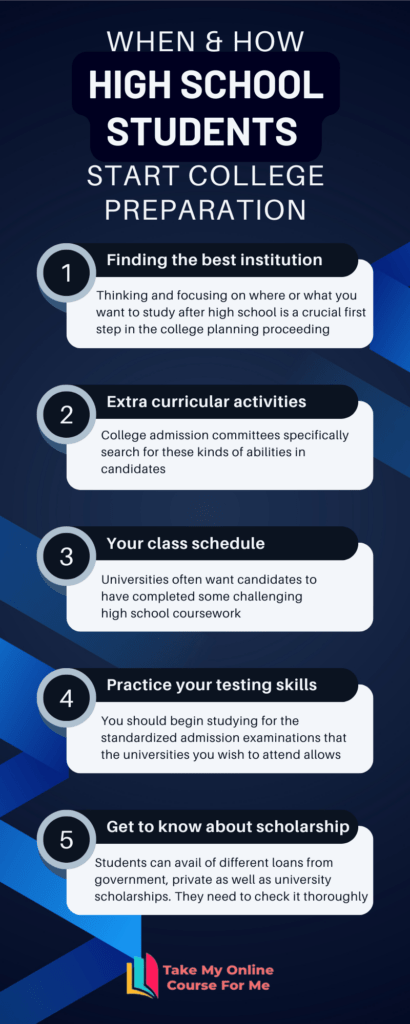
Let’s go over each step you’ll need to do to get started:
Finding the best institution
Thinking and focusing on where or what you want to study after high school is a crucial first step in the college planning proceedings. It’s recommended for you to go the nearby grad schools once you’ve begun compiling a lengthy list. You may even locate a campus tour close to any scheduled vacation spots. You may get a sense of what to expect at different institutions by visiting college campuses or attending college fairs, and you could be pleasantly surprised by what you find.
Participating in extracurricular activities
In addition to making high school far more enjoyable, extracurricular activities allow you to pursue your interests and pick up new abilities in ways that textbooks cannot.
More precisely, extracurricular activities may help you improve your teamwork, creativity, self-awareness, public speaking, leadership, and all the talents in between. Luckily, college admissions committees are specifically searching for these kinds of abilities in candidates.
Bulking up your class schedule
Universities often expect students to complete challenging high school coursework. That’s why it’s smart to take advanced options like Honors, IB, or AP classes during sophomore and junior years. They not only strengthen your transcript but also prove your dedication and may even save you money later.
However, math, especially algebra, can become a major hurdle for many students. If endless problem sets are draining your energy and affecting your focus on other important tasks like college applications, it might be time to look for help. Online math class services can step in and ensure you don’t fall behind.
These platforms employ expert mathematicians who can take your online classes, complete assignments, and keep your grades on track. Many students simply go to these sites and type requests like do my online algebra class, in the support section. From there, tutors handle the coursework while you gain valuable time to prepare for admissions, pursue extracurriculars, or just recharge.
With flexible scheduling and pocket-friendly rates, it’s a practical way to manage heavy coursework without compromising your academic goals.
Start practicing your testing skills
Although it may not be everyone’s favorite step in the application process, entrance tests are one of the most important requirements for admission to schools and universities. You should thus begin studying for the standardized admission examinations that the universities you wish to attend allow.
Not for giving up if your first attempt at the SAT or ACT doesn’t go as planned. Simply examine the areas where you need improvement, put in a lot of study time, and retake the test. Many students decide to take an admission exam more than once.
Start researching financial aid
The US Department of Education offers a variety of federal student aid programs, including grants and subsidized student loans. You can still opt for taking out a private loan from a mainstream lender, even though they sometimes don’t provide similar consumer protections as well as federal student loans.
The fact that interest rates on federal student loans are fixed is by far their greatest benefit. This helps you remain on top of your repayments and make future plans since it implies the amount of money you have to pay back each month won’t increase. Many private loans have variable rates, so the amount you pay may vary based on the state of the market or the performance of the company.
Follow the above-mentioned tips to better prepare for your higher studies and elevate your chances to enroll in your dream college by beating the competition.
Building Strong Study & Time-Management Skills
Unlike high school, college professors won’t constantly remind you of deadlines. Get used to planners, productivity apps, or simple to-do lists now. Learning to balance assignments, social life, and rest is a skill that will make your life much easier later.
Mental Health & Stress Management
College life comes with pressure, new environment, new friends, and higher expectations. Practice self-care now: exercise, meditation, journaling, or even just taking breaks. Seeking help from counselors or mentors isn’t a weakness—it’s strength.
Learning Life Skills
Don’t overlook basics like cooking, laundry, or time management. These may seem minor, but they’ll save you from unnecessary stress once you’re living on your own.
Networking Early
Start building connections—teachers, mentors, alumni, and even online student groups. These networks can help you with recommendations, internships, and guidance once you’re in college.
Read more: Why Exams Are the Most Important Aspects of Academics
Conclusion
College preparation may be somewhat demanding. Budgeting is something you should consider because money is a hard topic both inside and outside of school. On the other hand, scholarships can help you become ready for both college and life after graduation.
In short, for most students, college is a major adjustment. Academically, socially, and financially, there has been a significant shift. Planning should start as soon as feasible. But while preparing for college, there are several things to consider.
Therefore, it’s important to remember that academic achievement or extracurricular activities alone won’t get you into the school of your choice. You also need to consider tests, financing, and which school is best for you.
Frequently Asked Questions
| Question 1: How to start college life? Answer: Keep these tips in mind once you start classes, but more importantly, don’t forget to have fun along the way. Remember that every person you meet in college has something to offer you Be organized and make deadlines your priority Find a note-taking system that works well for you No not procrastinate ever Always back up your files |
| Question 2: What do colleges look for the most? Answer: You need to keep a few key things handy while preparing for college admissions. Here are these: Good grades Strong standardized test scores A well-written essay Extracurricular participation and leadership skills Diversity Enthusiasm for the school Letters of recommendation Enthusiasm for community work |
| Question 3: What does it mean by a good GPA? Answer: Whether an average GPA is good or not depends on your personal and academic objectives and the university and study program you choose. Usually, a GPA of 3.0 – 3.5 is considered good enough at many high schools, colleges, and universities. Top academic institutions usually require GPAs higher than 3.5. |