

Mathematics has long been considered one of the most challenging subjects for students. From early school years to university, many learners experience anxiety, frustration, and uncertainty when dealing with numbers, formulas, and complex problem-solving. Even in 2026, despite major advancements in online learning and digital education, math continues to be a significant academic hurdle.
However, the way students learn math is evolving. With interactive platforms, self-paced courses, AI-powered tools, and academic support services, mastering math is more achievable than ever before. When academic pressure increases, some students turn to online class help websites, asking, Can I pay someone to do my class for me? to manage competing priorities. Online academic assistance services connect students with experts who help them stay on track while they focus on exams, work, or other responsibilities.
This blog explains why students struggle with math, how online learning is transforming math education, and practical strategies to build confidence, improve performance, and overcome math anxiety.
Why Do Students Struggle with Math?
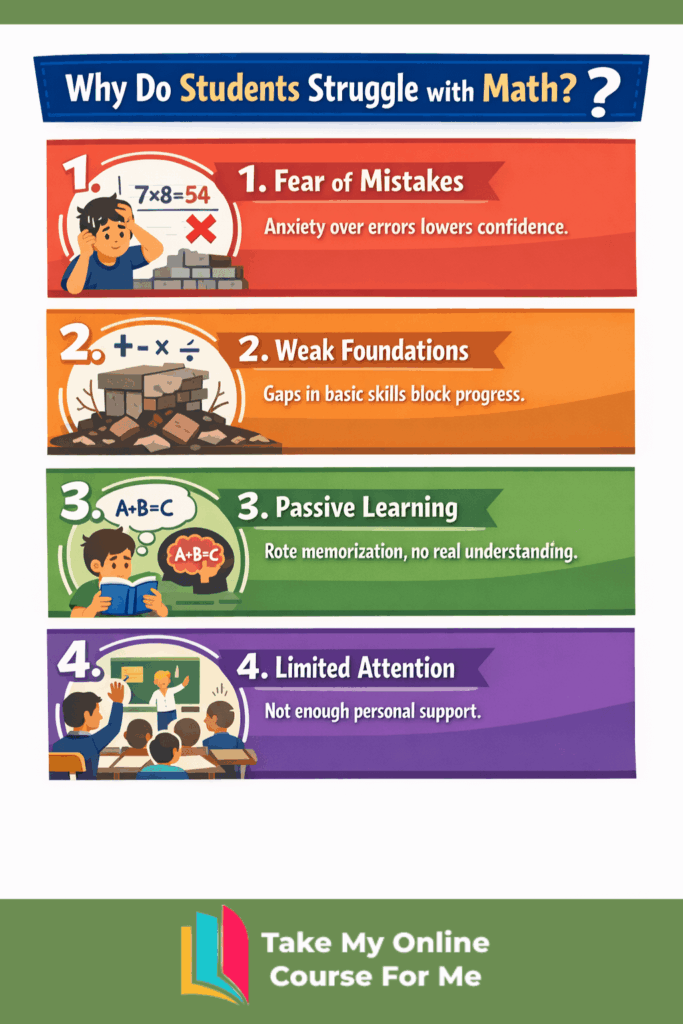
Understanding the root causes of math difficulties is the first step toward improvement. Most students do not struggle because they lack intelligence; rather, challenges often arise from gaps in learning methods or foundational knowledge.
1. Fear of Making Mistakes
Math problems often require multiple steps. A single error can lead to a wrong answer, which may discourage students. Over time, this fear reduces participation and limits willingness to try new problem-solving approaches.
2. Weak Foundational Knowledge
Mathematics is cumulative. Concepts such as fractions, decimals, and algebra form the base for advanced topics. If these basics are not fully understood, higher-level math becomes increasingly difficult. Small gaps can quickly grow into major academic obstacles.
3. Passive Learning
Memorizing formulas without understanding the reasoning behind them leads to surface-level learning. True mathematical competence requires conceptual clarity, not just memorization.
4. Lack of Individual Attention
In large classrooms, teachers often have limited time to address every student’s individual questions. As a result, some learners hesitate to seek clarification and gradually fall behind. This issue becomes even more serious in subjects like calculus because it is highly cumulative and concept-driven.
Additionally, calculus requires multi-step problem-solving and abstract thinking. A small mistake in an early step can lead to an incorrect final answer, which can be discouraging. Because of its pace and complexity, students who miss even a few classes may struggle to catch up on their own.
To prevent falling further behind, many students turn to online tutoring and structured academic assistance for personalized guidance. When deadlines, exams, and other responsibilities pile up, some may even post queries online such as, Can someone take my online calculus class for me? This usually reflects academic pressure rather than a lack of ability. A more effective long-term approach is seeking guided support, strengthening foundational skills, and managing time strategically so they can build true understanding and confidence in calculus.
How Online Learning Is Transforming Math Education
Digital education has significantly reshaped how students approach math. Instead of relying solely on traditional classroom lectures, students now have access to dynamic and flexible learning tools.
Interactive and Visual Learning
Animations, simulations, and step-by-step video explanations make abstract concepts easier to grasp. Visual demonstrations help students understand how equations apply in real-life situations.
Self-Paced Study
Unlike traditional classrooms where everyone follows the same pace, online courses allow students to pause, rewind, and revisit lessons. This flexibility is especially beneficial when tackling difficult math topics.
Instant Feedback and Practice
Many online platforms provide immediate feedback on quizzes and assignments. Students can identify mistakes instantly and correct misunderstandings before they become long-term problems.
Accessible Academic Support
When coursework becomes overwhelming, structured online support services offer guidance. Some students managing multiple responsibilities may consider options like pay someone to do my online class to free up time for strengthening core math skills.
Online learning has made math more interactive, flexible, and accessible than ever before.
Building a Strong Mathematical Foundation
Long-term success in math begins with mastering the basics. Without a solid foundation, advanced topics become intimidating and confusing.
Revisit Core Concepts Regularly
Students should consistently review essential topics such as arithmetic operations, fractions, percentages, and algebraic expressions. Even advanced learners benefit from refreshing foundational knowledge.
Focus on Conceptual Understanding
Rather than memorizing formulas, students should ask:
- Why does this formula work?
- How is it derived?
- Where can it be applied in real life?
Understanding the logic behind formulas improves retention and enhances problem-solving ability.
Practice Consistently
Math is a skill that improves with repetition. Practicing 20–30 minutes daily strengthens accuracy, speed, and confidence. Many online platforms offer structured practice modules that gradually increase in difficulty.
Effective Study Strategies for Math Success
Strong study habits can dramatically improve math performance.
- Instead of only watching lectures, students should actively solve problems. Writing out each step reinforces learning and builds analytical skills.
- Teaching a concept to someone else, or explaining it aloud, helps clarify understanding and reveal knowledge gaps.
- Large problems can feel overwhelming. Dividing them into smaller, manageable steps simplifies the process and reduces errors.
- Different students learn in different ways. Combining textbooks, online tutorials, discussion forums, and practice tools provides a well-rounded learning experience.
Overcoming Math Anxiety
Math anxiety can significantly impact academic performance. The pressure to achieve high grades often increases stress levels. While academic support can help manage workload, developing healthy coping strategies is equally important.
- Adopt a Growth Mindset: Replace negative thoughts like “I’m bad at math” with “I can improve with practice.” Progress comes from consistent effort and persistence.
- Accept Mistakes as Learning Opportunities: Errors are part of the learning process. Each mistake provides insight into areas that need improvement.
- Create a Productive Study Environment: A quiet, distraction-free space enhances concentration. Structured online classrooms can also provide a focused and supportive environment.
Leveraging Technology to Improve Math Skills
Technology has become a powerful ally in math education.
- Interactive apps provide guided solutions, instant corrections, and engaging exercises that make practice more effective.
- Digital tutoring services and discussion communities allow students to receive real-time explanations and feedback.
- Modern AI tools analyze student performance and recommend personalized exercises to accelerate improvement.
With these technological advancements, high-quality math education is accessible worldwide.
Balancing Math with Other Academic Responsibilities
Managing math alongside other courses, online classes, and extracurricular activities can be challenging. Effective time management is essential.
- Allocate dedicated time slots specifically for math practice to ensure consistent progress.
- Instead of attempting to complete an entire chapter at once, break it into manageable daily tasks.
Seek Help Early
Instead of allowing confusion to build over time, students should address doubts immediately to prevent stress from accumulating. When foundational concepts in subjects like algebra are unclear, students may feel overwhelmed and even search online phrases such as take my online algebra class for me, out of frustration. However, early intervention is far more effective. Academic support services, one-on-one tutoring, and collaborative study groups can clarify concepts before they become long-term obstacles. Seeking timely help ensures that small misunderstandings do not turn into major academic setbacks and helps students stay confident and in control of their progress.
Final Thoughts
Many students perceive math as impractical, but in reality, it plays a crucial role in everyday life and professional careers, including:
- Finance and budgeting
- Technology and programming
- Civil engineering and architecture
- Data analysis and research
- Artificial intelligence
- Everyday decision-making
When students understand the real-world applications of math, their motivation increases. Modern online courses increasingly integrate practical examples to demonstrate the relevance of mathematical concepts.
With the right mindset, consistent practice, smart study strategies, and access to supportive resources, students can overcome math fear and build lasting confidence.
FAQs
1. Why is math considered difficult for many students?
Math is cumulative and requires strong foundational knowledge. Gaps in earlier concepts often make advanced topics harder to understand.
2. How can I reduce math anxiety?
Practice consistently, adopt a growth mindset, review mistakes calmly, and seek help early when concepts are unclear.
3. Is online learning effective for math improvement?
Yes. Online platforms offer self-paced learning, interactive tools, instant feedback, and access to academic support.
4. How much time should I practice math daily?
Practicing 20–30 minutes daily is often enough to build consistency, confidence, and problem-solving speed.
5. What should I do if I fall behind in my online math class?
Review foundational concepts, create a study plan, use online resources, and seek tutoring or academic support to catch up effectively.